Dubai Introduces ‘Fountains Of Mercy’ To Support Wildlife And Urban Ecology
Fountains of Mercy reimagines how public space can serve both people and nature
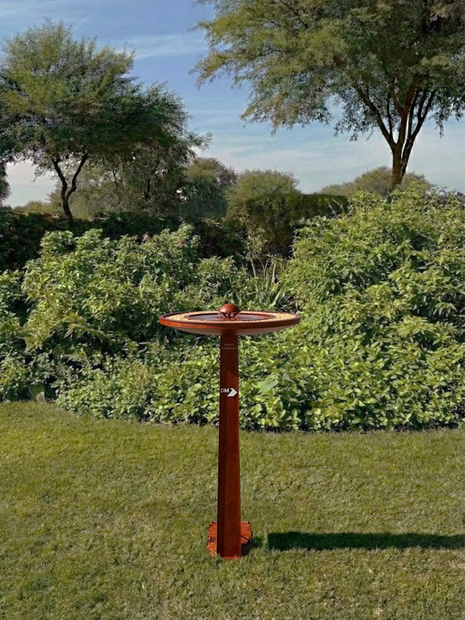
Fountains of Mercy, a civic design initiative announced by His Highness Sheikh Mohammed bin Rashid Al Maktoum, introduces a new approach to integrating care, generosity, and ecological responsibility into Dubai’s public spaces. Commisioned by Dubai Municipality, in alignment with the principles of the Dubai Civility Committee, and supported by a philanthropist, the ongoing initiative focuses on providing accessible water sources for birds across dense urban environments.
The initiative was designed, and curated by E+A Studio, with engineering and fabrication carried out in collaboration with Metalfabrik. Conceived as a quiet yet meaningful urban intervention, the fountains embed ecological support directly into the everyday fabric of the city, reinforcing the idea that civic care does not need to be monumental to be impactful.
Cities often underestimate how deeply nature shapes our mental clarity, emotional regulation, and sense of belonging. In the rush to optimise efficiency, density, and speed, something fundamental is often forgotten: cities are not closed systems. They are living environments, shaped as much by invisible relationships as by visible structures. When these relationships are disrupted, the consequences unfold quietly, yet profoundly.
As urban environments densify, natural ground cover gives way to hard surfaces, and access to water, shelter, and resting spaces for birds and small species becomes increasingly scarce. Each loss may seem minor in isolation, yet together they erode the delicate systems that allow life to coexist within the city. Migration routes shift, behaviours are altered, and food chains weaken, gradually thinning the ecological presence that once animated public space.
Over time, cities grow quieter in ways that are difficult to quantify but easy to feel. Birds are often among the first to disappear when conditions become inhospitable, and with them goes a layer of life that subtly informs how we experience our surroundings. Cities without these everyday ecological cues tend to feel harsher, more mechanical, and less legible – even when residents cannot easily articulate why.
“Preserving biodiversity is inseparable from preserving the quality of human experience,” says Evgeniia Molchanova, founder of E+A Studio. “They are not separate concerns, but part of the same living system.”
Fountains of Mercy responds to this absence not through spectacle, but through presence. By reintroducing access to water within dense urban environments, the initiative allows life to return visibly and meaningfully to the city. The movement of birds, the sound of wings, and the rhythm of daily visits introduce a layer of sensory information often missing from highly engineered urban spaces. Unlike signage or traffic, these cues do not demand attention; instead, they offer subtle reassurance to the nervous system – signals of continuity, balance, and care.
For those moving through the city, these moments soften the urban experience. They interrupt monotony without distraction, offering pauses that feel natural rather than designed. Watching a bird drink or take flight reconnects people, however briefly, to the living systems around them. In this way, supporting biodiversity becomes an act of civic kindness – one that nourishes both ecological and human well-being without instruction or performance.
Designed as a self-sustaining ecological intervention, Fountains of Mercy is fully solar-powered and operates independently within public space. Its autonomy reinforces resilience, allowing the fountain to exist without reliance on complex infrastructure or energy consumption. Constructed from Corten steel, the structure is designed to weather naturally over time, developing a patina that reflects its environment and allows it to age alongside the city rather than resist it.
“Corten steel was chosen because it allows the fountain to be preserved through time.” Evgeniia explains. “Rather than standing apart from the city, it becomes part of it, shaped by the same conditions as the surrounding landscape.”
The design was informed by the behaviour and scale of local bird species in Dubai. Proportions, access points, and placement were carefully calibrated to support natural patterns of use while remaining unobtrusive within daily urban life. The fountain does not compete for attention. It allows care to be present without announcing itself, reinforcing the idea that generosity can be quietly embedded into the fabric of the city and its people.
At its core, Fountains of Mercy reflects a belief that cities must evolve beyond serving human needs alone. In a time when urban development prioritises optimisation, the project introduces a different value system – one that recognises interdependence. It challenges the assumption that ecological care belongs only in parks or peripheral zones, demonstrating instead that it can be integrated into the everyday spaces we pass through without noticing.
By offering water and shelter, the project supports local ecosystems while encouraging a form of civic awareness rooted in observation rather than instruction. It invites responsibility through presence, not participation. In doing so, it reframes generosity not as symbolism, but as a civic practice – expressed through thoughtful, intentional design.
In a world where cities are increasingly asked to do more with less, Fountains of Mercy offers a quiet yet powerful proposition: that small, caring interventions – when designed with intention – can restore balance, health, and life to the shared environments we all inhabit.
Project Fact Sheet
Project name: Fountains of Mercy
Initiative announced by: His Highness Sheikh Mohammed bin Rashid Al Maktoum
Initiated by: Dubai Municipality
In alignment with: Dubai Civility Committee
Support: Philanthropic contribution
Design, engineering & implementation: E+A Studio
Engineering & fabrication: Metalfabrik
Location: Multiple public spaces across Dubai
Public announcement: 19 January 2026
Project status: Ongoing civic initiative