Mediterranean Architecture Meets Education: University Of Malaga’s Tourism Faculty
Completed in 2025, the Tourism Faculty at the University of Malaga merges modern educational needs with Mediterranean design principles
TYPOLOGY & TRADITION
Typologically, the building follows the tradition of educational architecture based on a system of aggregating volumes around courtyards, recovering the “cloister” as an organizational system, reminiscent of Mediterranean architecture where the climate favors open and landscaped spaces forming different types of courtyards.
TOPOGRAPHIC ADAPTATION AND VOLUMETRIC CORRESPONDENCE
The complex is affected by the restrictive airspace easement that limits the building’s height. This necessitates a large footprint and adaptation to the gently sloping topography.
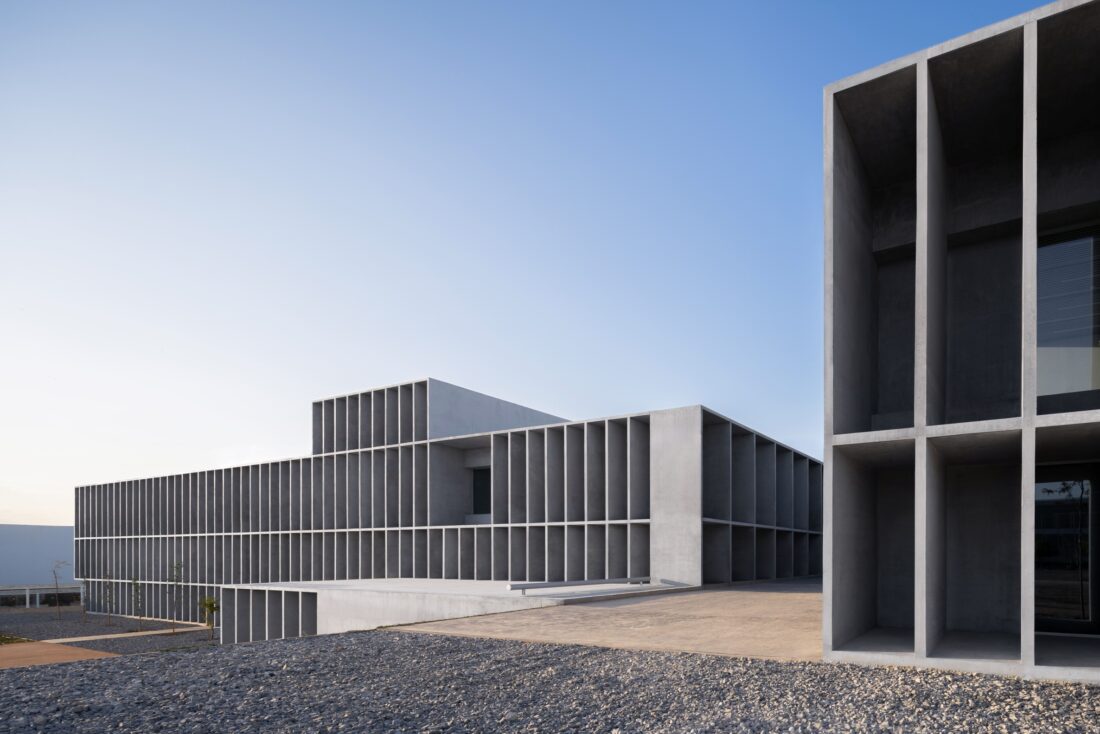
The proposal comprises three volumes arranged around a central atrium that organizes access and connections, creating a large, communal space that allows for diverse uses and functions within a high-quality environment. The volumes are staggered across the site, generating different platforms and gently sloping landscaped areas. Internally, each volume is organized around a courtyard/cloister, around which all activity revolves: 1- Classrooms and Laboratories of the Council Center; 2- Departments: Offices and Research; 3- Multipurpose Areas: Auditorium, Cafeteria, Library, and Dean’s Office.
FLEXIBILITY – TIMELESSNESS AND STRUCTURE
The proposal aims to offer a flexible and timeless architecture. To achieve this, a public scale closer to urban infrastructure is established. The structure becomes the essential architectural element of the project, capable of organizing the program and defining its image.
The building’s image is formed by an exposed, in-situ concrete structure, both interior and exterior, with very slender sections—15 cm thick.
The structural design around the perimeter seeks maximum interior flexibility through the use of walls of varying depths and deep beams spanning large distances, allowing for multiple interior layouts capable of accommodating different uses and programs.
MATERIAL AND PLACE
The building is conceived from a radical conceptual standpoint based on a unity of principles. The tectonic configuration is based on the exposed structure itself, and therefore the palette is minimalist, using locally sourced materials: local aggregates and cements for the concrete—hence its somewhat dark color; only plywood and glass act as infill for the concrete structure.
The overall design is based on passive systems, seeking natural efficiency and sustainability, promoting structural elements that integrate functions: the structural facades act as large solar shading screens, modifying their depth and density according to their orientation. The courtyards and atrium act as thermal buffer spaces, allowing cross ventilation to moderate the interior temperatures.
The landscaping is minimal, adapted to the current demands of extremely limited water resources—xeriscaping— using native species and permeable paving.




Latest Magazine